Friday, November 12, 2010

A Teaching Experiment Part II: Adjusting to the Technology

I recently posted about my involvement in a diversity week webinar lecture at West Virginia University. Since then, I had been involved in another distance-learning program related to the Citizens United v. Federal Election Commission decision that took place via videoconference; this project took a great deal of my time. (Jena Amerson blogged about the event--and its unfortunate mishap that took place--here.) Now that I have time to write after these events, I want to reflect on these two very different experiences in two separate blog posts. Today, I will reflect on the use of the distance learning technology for the diversity webinar. I will discuss the Citizens United videoconference in a later post.

First, the webinar was a great honor since it provided an open opportunity to discuss diversity in a university-wide lecture. Anyone with a suitable computer could “tune in” to the talk. A small group of university students, faculty, and staff did engage in the webinar—somewhere around 20 participants joined in the live broadcast. However, since the broadcast is saved at the WVU Extended Learning archive, it remains to be seen how many people will look at it.

Second, I want to reflect on the experience itself. One of the wonders of using the webinar technology was its ability to allow the webinar leader and the participants to conduct the seminar from virtually anywhere. All one has to possess is a laptop or computer with a camera and microphone installed—virtually any computer made in the last five years would qualify. What this meant for me was that I presented the webinar in the quiet of my office.

The challenge in this apparent convenience was that no one who participated in the webinar was present with me. The only interaction I received was from text-message like questions posed to me after I finished my discussion. This was a bit disconcerting: I sat, talking to just my computer and my camera and didn’t have any direct visual or aural replies. I felt that this required a significant adjustment to my approach to lecturing—indeed, I felt like I was literally performing for a camera and having to imagine from just the text on the screen whether my points were being received. Think of being by one’s self (no production staff, no audience, no director to cue you in) in a TV studio doing a live broadcast—an isolating experience.

This made me realize how much I depend on the in-person interactive quality of teaching in a “real life” classroom. The technology, though it allowed for anyone in cyberspace to follow my lecture, took this interactive layer away. I had to adjust on the fly to make it work (and my colleagues were helpful to me on this issue by mooting my talk for me the day before).

I think this issue of “adjusting to the technology” is one that anyone currently teaching and trying to make use of technology is going to encounter. I think the same thing I could say about using a virtual classroom can be said by anyone not used to things like PowerPoint, web sites, Wiki programs, etc. My only other observation is that devising such strategies as to particular technology and as to the process of technological change is going to matter more and more as technology in the classroom continues to evolve. It is a challenge we as teachers will continually face as our students—and the technology they bring with them—continue to evolve.

Tuesday, November 9, 2010

Lessons Learned ...


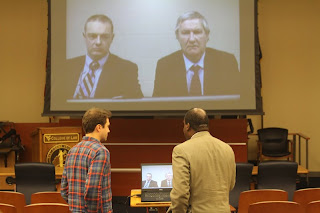
On Thursday November 4th Atiba Ellis organized a panel discussion with Professors Stephan Padfield and Wilson Huhn from the University of Akron. The panel was a perfect intersection of the issues that this blogs raises and the issues that I have been struggling with all semester: using new technology to incorporate case law across the curriculum. In this case, the new technology was Skype, which allowed us to engage in a two way video conferencing format: the professors at Akron could see us; hear the students questions and respond in real time. The "law" that they were discussing was the Citizens United case that (as mentioned in an earlier post) Atiba and I have been using as a means of engaging the students in issues of corporate law, constitutional law, and election law. In that way, the panel (taking place two days after the latest elections) was timely. Atiba mentioned the recent elections in his remarks and the professors at Akron elaborated and built on that in their reponses to student's questions.


The downside? The technology didn't work completely. What this blog entry was supposed to be, was a post with initial remarks from me followed by the video, so you could see for yourself how the Skype teachnology worked. Instead, because the technology didn't manage to record the event, you are left with my observations on the matter (supplemented with pictures to provide you with context).


So here are my observations:

I think that using technology in this way allowed the students to engage differently than they can with other formats. This is the digital generation, the students who grew up with mobile phones and text messaging; the ones who are accustomed to getting their questions answered instantly with a laptop and a wireless connection. Showing these students that we can engage with them using a technology they understand is invaluable in helping us to connect with them as teachers.

I've been thinking about this a lot in preparing for our upcoming presentation at the S.A.L.T. conference - using the intersection of technology and case law to connect with our students. Specifically, what is it about what we're doing (by having our students blog, have them use video, use a recent supreme Court case) that makes it different from previous methods of teaching?

Let's be honest, the idea of having one case that touches on multiple subject matters is not new - my students often tell me of finding a case that they've read in one class's casebook being used in another casebook for a different subject. That makes sense- one judge can touch on a multitude of different legal theories in a single opinion; it's only natural that different casebook authors (and law school teachers) would use a portion for their own purposes.

So what makes our experiment so different? The conclusion I've reached (which I'm still thinking through) is that it's the combination of the timeliness, the technology and the richness of the case that makes this an effective way to teach to students. Unlike cases that have already been compiled and edited for casebook purposes - Citizens United is new, the Supreme Court just decided the case this year. In addition, my students had to read it unabridged, no editing or censoring on my part. Finally, my students had to use technology (by blogging at least twice throughout the semester) to think through the issues that Citizens United raised. It was almost as if they were defining for themselves what Citizens United meant across all these different areas of the law: they were analyzing it; massaging it; trying to firgure out how it all fit together in a way that I think they could not have done without blogging. And then, to hear some of the thoughts that they had struggled with being echoed by professors and scholars ... the feedback that I've had so far has been overwhelmingly positive. As one student in business organizations class noted -it was like bringing in all these different threads together.

So, while it would have been nice to have had a video to record the moment (and the four professors have decided that we are going to have a wrap up session which we will record and post) I think the far more valuable thing that this panel (and this semester) has shown me is that, if you take the time to think about different ways you can engage your students and you supplement that with timely issues that they want to understand, the results can be astounding...

Monday, November 1, 2010

Citizens and Beyond …

The Supreme Court on September 28th granted certiorari yesterday regarding whether to expand corporate rights in other contexts. The cases, will involve the application of the state secrets doctrine and invocation of the right to privacy by a corporation (General Dynamics Corp. v. United States and The Boeing Company v. United States, Nos. 09-1298 & 09-1302). It will be interesting to watch in the coming months how the experts will analyze these cases, especially in light of the Court's recent Supreme Court decision Citizens United v. Federal Election Commission.

While I’m sure that I will have strong opinions on the cases as a scholar when they are decided by the Supreme Court, my primary interest in these right now is as a teacher. One of the points of this semester long project that Atiba Ellis and I have is trying to find ways to teach across the curriculum. Only the most superficial logic would deny the overlapping nature between one aspect of a curriculum and another. In fact, on the first day of my business organizations class I challenge my students to find one course that they are taking or have taken where business and business organization issues are not implicated. In the two years that I have made that challenge I have yet to be stumped to find a connection.

Last month, I co-taught a class for andre cummings entertainment law course on piercing the corporate veil. dre certainly didn't need the help – he has taught this course numerous times and has a strong business background. Still, I couldn’t argue with his logic in getting me to co-teach with him: according to dre, it’s creative and offers students a different perspective. I agree with dre. I also think it breathes life into students who, for this generation at least, seem quick to view things as monotonous and repetitive. In my own experiences teaching Legal Writing I also found this to be so – I could give my students my core tips repeatedly over the semester but, as soon as I have a guest lecturer who comes in and, in essence, repeats those same tips to them, suddenly the students get it.

So what does all this have to do with the Supreme Court’s docket? Well, in the coming weeks I will look for ways to incorporate these issues into my business organizations and corporate governance classes. My corporate governance students in particular, who are just beginning to draft their seminar papers, might find it interesting to make connections between a corporation’s 1st amendment rights (as discussed in Citizens) and a corporation’s right to privacy. In my business organizations class we recently discussed the issues of duties for members of the board of directors and the rights of shareholders to bring derivative lawsuits if they feel that the corporations are not invoking invoking their rights. The example I gave my students is a variant on an example that Mark Ramseyer gives when he teaches his students this segment: what if Iron Man, the treasurer for S.H.I.EL.D. corporation, suddenly decided that SHIELD’s iron man suits are his and his alone and steals them from the corporation. If the company refuses to sue (preferring to take matters in their own hands) then a shareholder of S.H.I.E.L.D. would have the right to bring a derivative lawsuit in the corporation’s name suing to get the Iron Man suits back. One of the things that I will ask my students is, would the principles of derivative lawsuits apply in those situations where a shareholder is seeking to invoke a corporation’s right to privacy? What are the implications when the rights that a shareholder is trying to enforce are not monetary or fiduciary but constitutional? SInce we have a guest lecturer who will be talking with my students on Thursday about the Citizens United case, this seems like an ideal setting to pose these questions.

Hopefully, getting them to think about this in one context will encourage them to think about it in other contexts. I would love to hear suggestions from other teachers out there for what they do to teach across curricula…

Thursday, October 21, 2010

Webinar: A Teaching Experiment Part I

I recently had the honor of giving a university lecture on diversity for West Virginia University's Diversity Week 2010. The title of my talk was "The Diversity Rationale: What it Means and Why it Matters."

Rather than the usual stand-up-in-an-auditorium-and-talk format, I presented the talk via webinar. It was sponsored by WVU Extended Learning. The link to the archived here. (Note that you have to have an updated version of Java in order to access the program.) I would appreciate your feedback on how it (the webinar) came across, its utility -- particularly from the point of view of a student who happened upon the discussion -- and how useful this approach may be for teaching purposes.

In a subsequent posting, I plan to reflect in depth on my experiences in using a webinar as a teaching and lecturing medium. Suffice it to say for now that the experience was "surreal."

ARE

Wednesday, October 20, 2010

Characteristics of the Millennials – Part 2: They’re Confident & Team-Oriented

This is the second post in a series regarding the characteristics of Millennials. In part one, I discussed the first two characteristics that I have learned about this group: that they are confident and team-oriented. In this post I would like to discuss two other characteristics: that they are achievement oriented and conventional.

They’re Achievement Oriented
Quite frankly, I don’t know if law professors will see a significance difference in this characteristic than in previous generations (although, being a younger professor, I have no personal point of reference). My understanding of the typical personality type that attends law school is that they have classic Type A attributes: they are achievement oriented, always prepared, and typically used to succeeding.

Research I have seen on this supports that idea. For instance Susan Daicoff, a Professor of Law, writes extensively on the personality traits of lawyers and law students. In a 1997 article entitled “Articles Lawyer , Know Thyself : A Review of Empirical Research on Attorney Attributes Bearing on Professionalism,” she discusses the findings from studies regarding the attributes of lawyers at various stages: before they enter law school (from early childhood through college); during law school and after they graduate. In summarizing the findings regarding law students Prof. Daicoff writes “the research … suggests, although with some expected gender differences, that law students are motivated by achievement rather than altruism.” For me, the most interesting aspect of Prof. Daicoff’s piece is its publication date – 1997. That year is significant for me because it’s the year I graduated from law school. As such, it seems that this particular aspect of the law student’s personality is consistent with previous generations.

The anomaly then might be in comparing law students to non-law students. What could be happening is that, while law students’ achievement orientation is remaining constant, the achievement oriented nature of the general millennial population has risen to a comparable level.

I would love for both law and non-law faculty who have been teaching for a number of years to chime in on this. In particular, I would like to know if either group has seen a change in how ambitious these latest crops of students are compared to previous years.

They’re Conventional
My understanding from Grace is that by conventional, these groups of students are generally more conservative than previous generations. Certainly, compared to those who attended law school in the 1960s, there must be a significant difference in the political leanings and civil rights activism - I have heard of no sit-ins at law schools in the last few years.

Personally, hearing that this generation is conservative sheds some light on the type of class that I teach and the resistance that I have encountered in my two years of teaching this course. As I mentioned in a previous post, the classes that I teach are mainly business courses: business organizations; securities regulation; international business transactions and a corporate governance seminar. Although I had anticipated that many of my students would have a business focus and thus, could be characterized as more conventional (as compared to, say students enrolled in a human rights class), I had thought that the specter of the bar examination would draw in otherwise left-leaning students who needed a crash course on these issues before taking the exam.

For me, there is no contradiction between having a strong business foundation and a more progressive, civil rights based mindset. However, I was surprised to discover that most of my students (even the ones with no interest in business) were by far more conventional. The most obvious example of this was when I showed my students the movie The Corporation. The movie is a documentary with a clear bias – its basic premise is that many of the characteristics of the modern publicly traded corporation are similar to those of a psychopath. It is based on a book by Joel Bakan that seems thoroughly researched but is no less provocative.

I present the movie in my class, not because I agree whole-heartedly with everything the movie says (I don’t), but because I believe that it’s a good way to stimulate paideia – getting students to question the idea of what a corporation is for. For instance, is a corporation simply there to generate earnings for its shareholders (as we learn in the black letter law)? Or are there other stakeholders that we should consider? Why or why not?

I imagined that this movie would engender a lively debate among my students. Instead, my students have, by and large, reacted very negatively to the ideas contained in the movie. Instead of a lively debate, I am often met with disdain for the idea that a corporation should be anything but a profit making machine. I wonder if I have presented this movie a decade ago whether it would garner the same response.

Of course, any attempt to extricate general attributes from such a large and diverse population is always fraught with peril; the idea of distilling the essence of a generation seems to me an enormous empirical challenge. Nonetheless, the findings are significant. Being able to understand the type of students that I am teaching, even at a superficial level, can help me (I hope) to be a better teacher, one who can understand her audience and tailor her teaching methods accordingly. Many good teachers do no less now when they tailor their teaching style to the various ways that people learn. Doing so on a generational level would allow for additional means of reaching them.

Wednesday, October 13, 2010

Example of Teaching to Millenials

Prof. Charles Calleros, of the Sandra Day O'Connor College of Law at Arizona State University, has provided us with this excellent example (given by his son Alex) of using technology to teach to generation millenials. The video shows how animation can covert what would otherwise be an ordinary lecture into a fun, entertaining and memorable event.

This particular example has Prof. Phillip Zimbardo lecturing on the different perspectives of time ...

Tuesday, October 12, 2010

Characteristics of the Millennials – Part 1: They’re Confident & Team-Oriented

In a previous post I discussed the research that WVU Law’s Director of Academic Excellence, Grace Wigal had presented regarding Millennials. It was a fascinating presentation to listen to because it shed light, from a generational perspective, on some of the tools that I has used in teaching this group and how they were received. In this post I will explore two of the characteristics that Grace discussed: their confidence and team oriented nature. In the next post, I will discuss two others: They’re goal oriented and conventional (conservative) nature.

They’re Confident:
The courses that I teach at the College of Law are part of the law school’s business curriculum. In the fall, I teach Business Organizations and a Corporate Governance Seminar. In the Spring, I teach Securities Regulation and International Business Transactions. My Business Organizations course (which many students treat as a required course since it is tested on most bar exams) is by far the largest class I teach in the year. Last year, I had approximately 75 students. This year I have close to that number: approximately 70. What has surprised me more is the sheer confidence that students have when presenting a case or questioning a legal issue. There are always a core group of students who speak up in class and present their ideas. What impresses me about them is that, even if they are on the completely wrong track, or give the wrong answer to a question – they are undeterred; they simply pick themselves up and do it again.

Contrast this with an experience a classmate of mine had when he was in law school (approximately fifteen years ago). He remembers vividly being called on in 1st year contracts to present a case and, being devastated when the teacher dismissed his analysis. Here’s the thing – my friend traces that one single event to his poor performance in law school. That one experience destroyed his confidence and he feels he never recovered. In fact, I remember the day it happened and indeed, my friend truly never was the same after that.

Now does my friend’s experience exemplify our generation’s lack of relative confidence? Perhaps not, but I was a fairly outspoken person in law school and I can still remember being terrified at the thought of being unprepared, particularly in a class the size of mine. Certainly, if I had been summarily dismissed by a professor I would not have immediately jumped back on the horse and volunteered again in the same class period. So, this does seem to be a change and, welcome at that – makes me think that these group of students will be more likely than a generation ago to separate their failings in class from their value as a law student.

They’re Team-Oriented:
Based on what Grace has said in her research, these groups of students are team-oriented: they have taken to heart George Bush’s mantra – no child should be left behind. By inference, group activities would seem to go over better with this group of students than with others. I have seen that borne out in my own experiences with my Business Organizations class. One of the components of my class is that in addition to the doctrinal issues, I have my students complete various drafting exercises based on what we learn, so that they have a practical application for some of the doctrinal issues that we cover. The students draft partnership agreements, bylaws, shareholder proposals etc… Last year, I had my students complete each of these assignments individually. This year, on the advice of one of my students, I turned these into group assignments. So far, they have only completed one, but the feedback that I received from the class was exceedingly positive (in contrast to the feedback I received last year which was lukewarm at best). Now maybe it’s just that they could divide the work between many people this year – but I truly don’t think that’s it. Rather, it seems like focusing on this assignment in groups allowed them to delve more deeply into the issues implicated by the drafting exercise and really think about the implications for what a partnership agreement would look like. Going over what they handed in was one of the best classes I had this semester.

So what have your experiences been? If you’re a student, do you agree with team-oriented exercises? If you’re a professor, do you think that this approach works? I would be particularly interested in hearing from business school professors, who have long employed group methods along with case-studies in their classroom.